

How Claude AI Integrates with Technical Data Streams
Unlike many earlier AI models, Claude AI has a very large context window. This means the system can read and analyze hundreds of pages of documentation at once. For technical organizations, this is a key requirement, as construction projects rarely consist of isolated text fragments. The power of the technology lies in establishing connections between different documents and returning information in a structured manner, while ensuring that company data remains protected from public training data within secure business environments.

Support for BIM and Information Management
In projects that use Building Information Modeling (BIM), a constant stream of supporting documentation is generated. Claude AI does not take over 3D modeling tasks, but acts as an analysis layer around the project data. Project managers and BIM coordinators can use the model to quickly filter specific requirements from a BIM Execution Plan (BUP) or Information Delivery Specification (ILS). In addition, the technology helps verify exported data—such as IFC lists and material tables—for missing parameters or inconsistencies between the model and the specifications.

Streamlining Estimation, Work Planning, and Quotations
Preparing an accurate construction bid requires a careful review of tender documents, such as STABU or RAW specifications. Claude AI can summarize these documents and immediately highlight the most important risks, specific material requirements, and deviations from standard terms and conditions. During the cost estimation and work planning phases, the system helps compare supplier quotes at a detailed level and translates internal cost data into clear, consistent quote texts.

Permit Processes and the Digital System for the Environment Act
Complex textual processes play a major role for both the applicant and the reviewing authority. Architects and engineering firms can use Claude AI to prepare permit applications for the Digital System for the Environment Act (DSO) and check them in advance for completeness. On the municipal side, the technology supports permit issuers and case managers in organizing incoming applications. Extensive spatial justifications, reports, and any statements of opinion are summarized more quickly, making the substantive assessment more efficient.

Compliance with Building Codes and Quality Assurance
Compliance with laws and regulations requires a thorough review of design principles and implementation plans. Claude AI can be used to assess project documentation against the frameworks of the Building and Living Environment Decree (Bbl) and relevant NEN standards. The model also provides support within the framework of the Construction Quality Assurance Act (Wkb). It helps verify quality assurance plans and systematically compile the final acceptance dossier, with human experts always retaining final approval authority.

Data-Driven Building Management and Maintenance
After completion, the focus shifts to the management and maintenance of buildings and systems. Property managers and maintenance companies often have years of failure history and stacks of inspection reports. Claude AI can analyze this historical data to identify patterns and more quickly develop a well-founded Long-Term Maintenance Plan (MJOP). For service technicians on-site, a link to the internal knowledge base ensures that relevant sections from maintenance manuals and system diagrams can be accessed immediately during a malfunction.
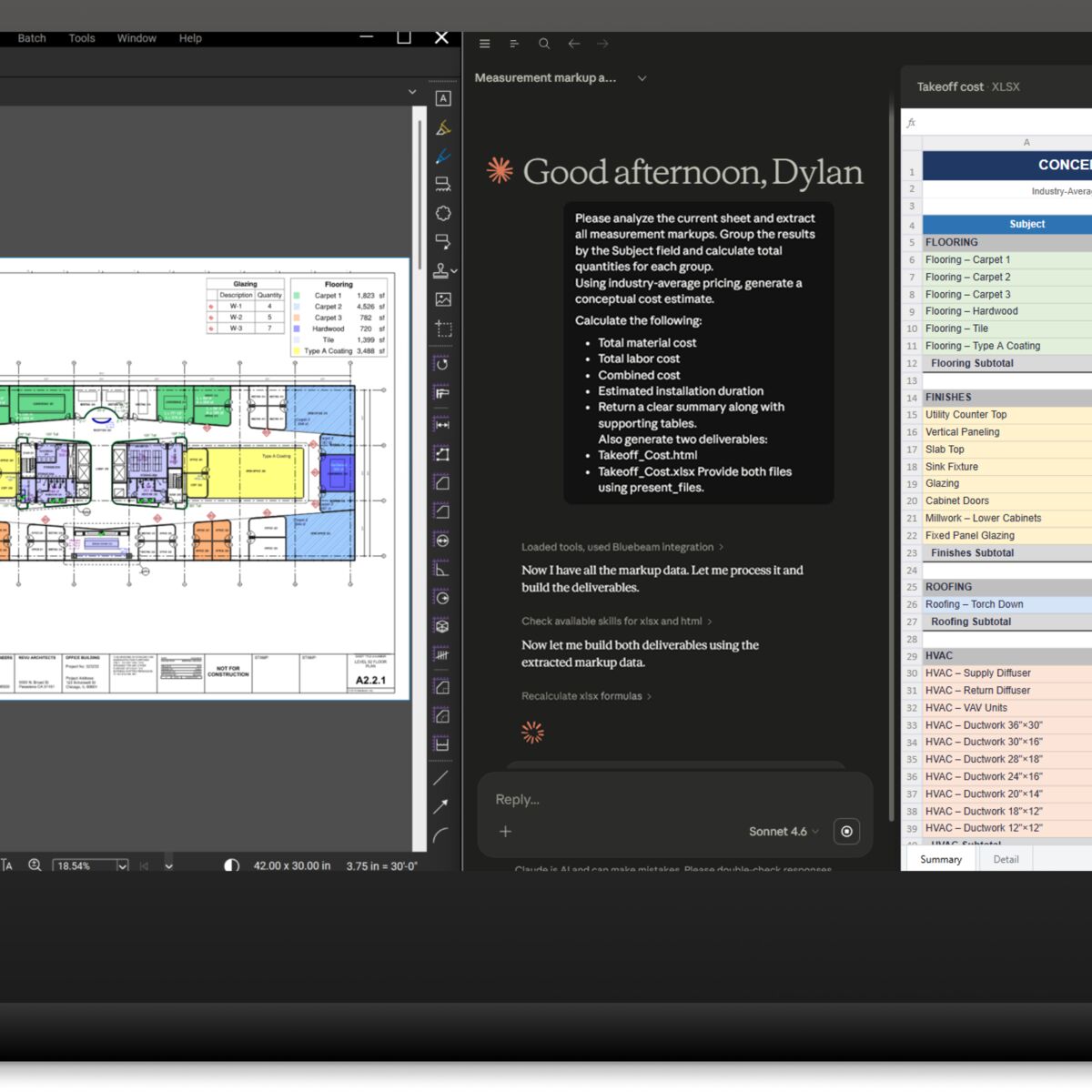
AI Integration in Bluebeam Max and Your Existing IT Infrastructure
A key example of how generative AI is being integrated directly into existing construction software is the integration between Claude AI and Bluebeam Max. Through the Model Context Protocol (MCP), Claude works directly with Bluebeam Revu, allowing users to search drawings, analyze markups and metadata, and identify revision differences more quickly using natural language commands.
This webpage was last updated on 11/12/2026. For the latest updates, visit Claude’s website.